
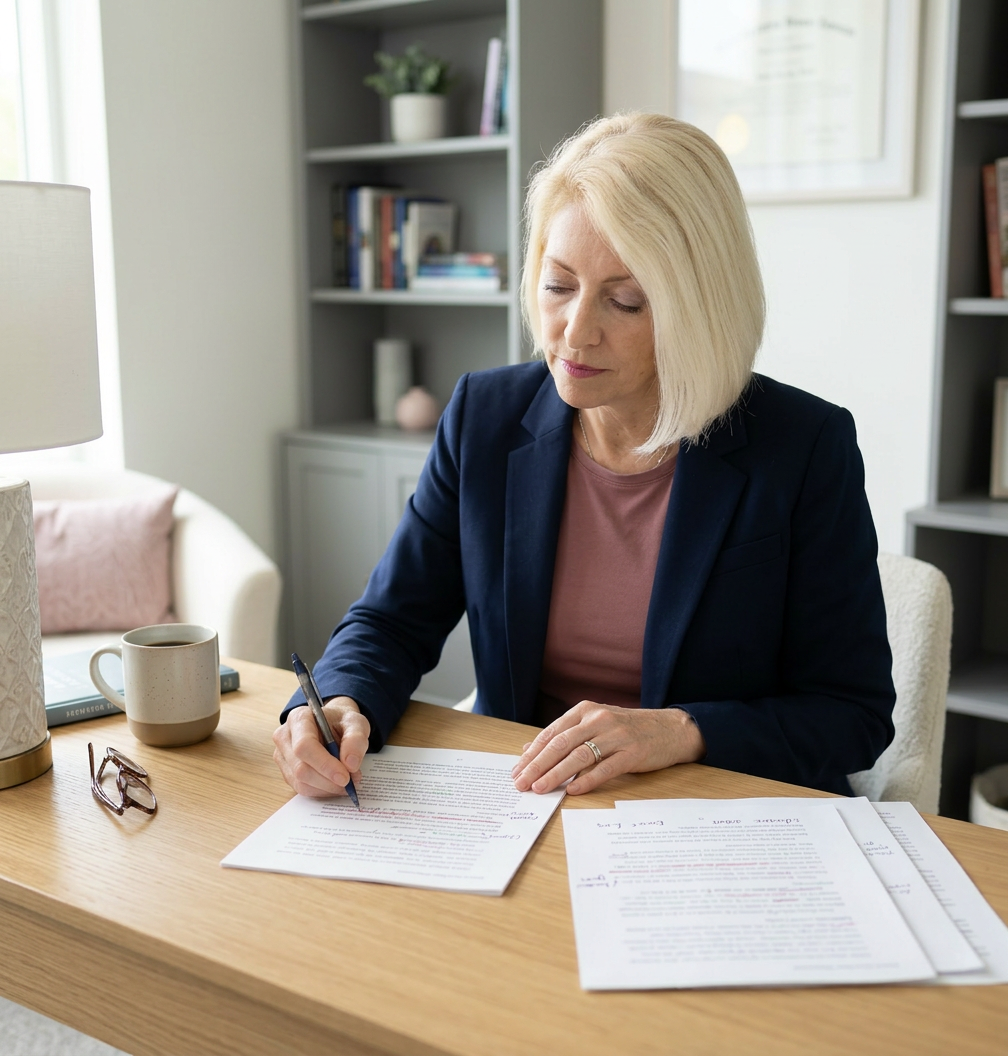
Victoria noticed it first in meetings.
She had always been sharp in boardrooms — quick to read the dynamic, confident in her position, able to hold a lot of information at once. But lately something was different. Her mind kept drifting. Not dramatically, not in ways anyone else would notice. Just — elsewhere. Returning to a conversation from the night before, the one that had started in the kitchen and ended without resolution, again.
She was still performing. But it was costing her more than it used to.
What unsettled her most was something she hadn't admitted to anyone: she felt more at ease at work than she did at home. The professional environment, with its clear expectations and solvable problems, had become a kind of relief. Home was where the tension lived — low, constant, never quite resolved — and apparently it had started following her out the door.
Why does relationship stress follow you into work?
A high-achieving woman is usually skilled at compartmentalizing. She can hold pressure at work without bringing it home, manage a difficult client without letting it affect her evening, keep the professional and personal in their separate places.
What is harder to contain is something unresolved. It intrudes into the workday and commands attention she wants to give something else.
Functioning at full capacity requires a mind that is fully present, and part of hers is anticipating what she finds when getting home. That is not failing to focus. It is the predictable effect of a problem that has gone unaddressed for too long.
How does dealing with emotional load at home affect your performance at work?
When one partner has taken on most of the emotional responsibility for the relationship — noticing the tension, initiating the conversations, thinking through what needs to change — the mental load doesn't clock out at the end of the day.
Small things feel more irritating than they should. Decisions that would normally be straightforward require more effort. The patience she relies on professionally runs thinner than usual. She finds herself relieved when work keeps her too busy to think about what's waiting at home.
None of these are signs of weakness.
They are signs that something has shifted in the balance she depends on. Work takes energy, which is normal, and she is good at what she does.
But you want to come home to replenish.
When home has become another place where everything lands on her, there is nowhere left to restore what the day used up.
When does work feel easier than being at home?
There is a particular moment when many women realize they feel more at ease at work than in their own home.
At work, problems have structure. Effort leads to results. The rules are clear enough that competence is sufficient.
At home, the same effort doesn't produce the same return. Conversations circle. Tension lingers. The intelligence she applies to everything else hasn't been enough here — and that gap, for a woman who is used to figuring things out, is its own kind of exhaustion.
When work becomes the relief and home becomes the weight, it is usually a sign that something in the relationship has been unaddressed for long enough that it has started to cost her in domains she cannot afford.
Does getting clarity about your marriage actually change anything?
Yes — but not in the way you might expect.
It doesn't resolve the relationship overnight. What it does is address what has been dividing your attention — the unresolved tension that follows you into your workday, the mental space taken up by conversations you haven't had, the low-level vigilance that never quite switches off.
Clarity does not force a decision. It makes a decision possible.
When the pattern becomes visible — what has accumulated, how the dynamic developed, what you have been putting up with and for how long — that divided attention begins to settle. Not because the situation has been resolved, but because you can see it clearly enough to know what you want to do about it.
A next step
If you recognize this — the divided attention, the relief of work, the sense that something at home is costing you professionally — it is worth understanding what is actually happening before the cost grows.
The Relationship Alignment Deep Dive is a focused, private session designed for exactly this moment — to examine what has been accumulating beneath the surface, and what direction makes the most sense from here.
You can read more about the Relationship Alignment Deep Dive here.
Frequently asked questions
Can relationship problems affect your work performance?
Absolutely — and more so than most people realize. The effect is rarely dramatic. She doesn't fall apart at her desk. What happens is subtler: a mind that is partially elsewhere, patience that runs thinner than usual, decisions that require more effort than they should because of the constant mental distraction. She is still performing. But it costs more than it used to. Over time, that additional cost accumulates — in focus, in leadership presence, in the quality of attention she brings to work she cares about.
Why do I feel more relaxed at work than at home?
At work, you are in your element. You are respected. People trust you. You know what you have to do to produce desired results. At home, everything is different. You imagine outcomes from a conversation, but that's not the way it goes. The competence that serves you everywhere else doesn't seem enough here. When one environment consistently restores and the other consistently depletes you, the contrast becomes impossible to ignore.
How do I focus at work when my marriage is struggling?
The honest answer is that focus is hard to manufacture when something significant is unresolved. You can manage it for a while — most capable women do — but managing is not the same as being fully present. The most direct route back to focus is not a productivity technique. It is understanding what is creating the distraction clearly enough that something can actually shift. Clarity about the relationship tends to restore the energy the relationship has been consuming.
Does it mean everything's over if work feels like an escape from home?
Not necessarily — but it is a sign worth taking seriously. Work becoming a relief is not a failure. It is a logical response to a home environment where tension is chronic and effort goes unreturned. But when the place you go to recover has become the place you escape from, the balance you depend on has shifted in a way that isn't sustainable.
The relief you feel when you're out the door in the morning — that is the feeling worth paying attention to. It is usually telling you that something at home needed to be examined for longer than you have been willing to admit.